
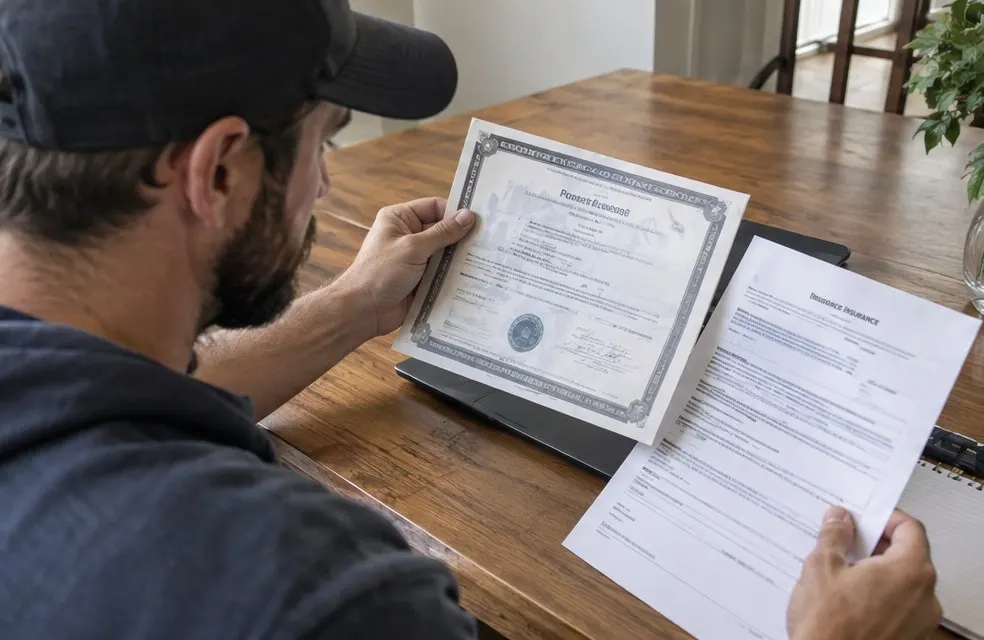
"Do you need a license to be a handyman?" has no single answer in the US. It depends on your state, your county, your city and the kind of work you do. Getting it wrong can mean fines, jobs you cannot collect on and insurance that will not pay. Here is how to figure out where you stand. This is general information, not legal advice; always check with your state licensing board.
The three questions that decide it
- Does your state have a dollar limit for work without a contractor license?
- Is the work a licensed trade (electrical, plumbing, HVAC, gas, roofing, structural)?
- Does your city or county require its own license, registration or business tax receipt?
Dollar limits
Many states let you do small jobs without a general contractor license if the total (labor and materials) stays under a limit. Some examples:
- California: work under $1,000 per job, including materials, since 2025 (it was $500 before). You must say in your ads that you are not licensed
- Arizona: a similar exemption for minor work under $1,000 that does not need a permit
- Florida: no state handyman license, but you cannot do work that requires a licensed contractor, and many counties have their own rules
- Texas: no state general contractor license, but plumbing, electrical and HVAC are licensed at the state level
Rules change. Look up your state's contractor licensing board and search for "minor work exemption" or "handyman exemption".
Splitting jobs does not work
If your state's limit is $1,000, you cannot split a $3,000 job into three invoices. Licensing boards treat that as one job.
Licensed trades
In almost every state, these need a licensed professional no matter how small:
- Running new electrical circuits or adding outlets
- Plumbing beyond simple fixture swaps in some states, and anything touching supply or drain lines in others
- Gas lines and gas appliances
- HVAC work
- Structural changes: removing walls, cutting joists
- Roofing, in many states
Replacing a light fixture or a faucet on an existing connection is allowed for handymen in some states and not in others. When in doubt, refer it out. A good relationship with a licensed electrician and plumber also brings work back to you.
Local licenses
Even where the state does not license handymen, your city or county may require a business license or business tax receipt, and some require a competency card for specific work. These usually cost $50 to $300 a year.
Insurance
Licensed or not, carry insurance. One accident can cost more than a year of income.
- General liability: covers damage to the customer's property and injuries to others. $1 million per occurrence is standard. A solo handyman often pays $40 to $100 a month
- Commercial auto: your personal auto policy may not cover a truck used for business
- Tools and equipment: covers stolen or damaged tools, often $10 to $25 a month
- Workers' compensation: required in most states once you hire employees
Many property managers, HOAs and realtors will ask for a certificate of insurance before you start. Have the PDF ready to send.
Bonds
Some states and cities require a license bond for certain contractors. It is not insurance; it protects the customer if you do not finish or follow the law. Small bonds often cost $100 to $300 a year.
Permits
Some small jobs still need a permit: a new water heater, a new circuit, a fence over a certain height, a deck. Pulling a permit usually requires a license. If a customer asks you to skip the permit, say no; unpermitted work can void their homeowner's insurance and come back to you.
How to talk about it with customers
Be clear on your website and in your quotes:
- "Insured, $1 million general liability"
- The jobs you do and the jobs you refer to licensed trades
- Your license number, if you have one
Customers trust a handyman who says "that one needs an electrician, here is who I use" more than one who says yes to everything. Put this on your handyman website so it answers the question before the call.
Next steps
Once you know what you can do, set your list of jobs and your prices. Read how to start a handyman business for the full checklist and handyman prices for common jobs for typical ranges.
Frequently asked questions
Can I be a handyman without a license?
In many states, yes, for small jobs under a dollar limit and outside licensed trades. California, for example, allows jobs under $1,000 including materials. Check your state licensing board and your city.
How much is handyman insurance?
General liability for a solo handyman often costs $40 to $100 a month for $1 million per occurrence. Commercial auto, tool coverage and workers compensation are separate.