
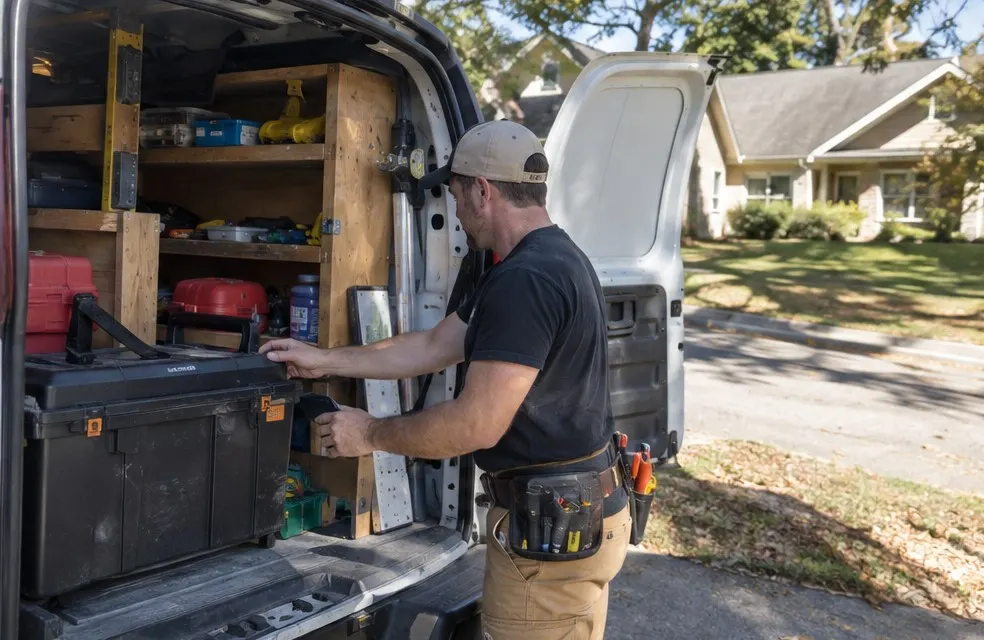
A handyman's income is the number of billable hours in a week. Every gap in the day, every 30-minute drive across town and every customer who is not home is money you do not get back. Good scheduling is not about software first. It is about a few rules that keep the day full and the drive short.
Think in blocks, not appointments
Most handyman jobs fit into one of three sizes:
- Short (1 to 2 hours): a TV mount, a door, a couple of patches
- Half day (4 hours): a list of small fixes, a wardrobe and two dressers
- Full day (8 hours): a move-in list, a rental turnover
Plan each day as two half-day blocks or four short slots. When someone books a short job, it fills one slot, not the whole morning.
Zone your week
Assign towns or neighborhoods to days: Monday and Thursday in Plantation and Sunrise, Tuesday in Davie and Cooper City, and so on. Tell customers "I am in your area Tuesday and Friday." Most are fine with that when the date is close. Cutting one 30-minute cross-town drive a day gives you back about 10 hours a month.
Keep one same-day slot open
Same-day calls are often the best paying calls you get: a door that will not lock, a leak under the sink, a TV that has to be up before the party tonight. Leave one slot open each day, usually early afternoon, for same-day work. If nobody books it by 10 a.m., release it to the next day's list.
Charge for same-day service. A $50 to $100 add-on is normal, and customers who need it today rarely argue. Put it in your calculator so they see it before they book.
Set a minimum and protect it
A 20-minute job across town costs you 90 minutes. Your first-hour price or minimum charge covers that. If you do not charge one yet, read how much to charge as a handyman.
Also try to stack small jobs. When a customer books a 30-minute fix, ask: "Anything else on your list while I am there?" Most people have two or three more things.
Let customers book online
Phone tag kills small jobs. A customer who sees your open slots and books one is a done deal; one who leaves a message may book someone else before you call back.
With online scheduling, you set the days, the hours, the towns and how far ahead people can book. Customers see only real open slots. Same-day slots appear only when you leave room for them.
Reminders stop no-shows
Nothing wastes a morning like driving to a house where nobody answers. Send a reminder the day before and the morning of the visit, with the time and what to have ready: "Have the TV and bracket in the room, clear the wall." A two-line text saves you an hour.
Ask the right questions before you go
Every surprise on site costs time. Before the visit, know:
- What exactly is broken, with a photo if possible
- Wall type for mounting (drywall, plaster, brick)
- Whether the customer has the parts or you need to pick them up
- Parking, gate codes, pets
- Who will be home
Your booking form or your answering service can collect these so you arrive with the right tools.
Batch parts runs
Store trips are unbilled time. Buy common parts in bulk (anchors, screws, caulk, mud, wire, door hardware) and keep them in the truck. For job-specific parts, charge a materials pickup fee and do the run once a day for all jobs.
Running late
Text the next customer as soon as you know, with a new time. People forgive late; they do not forgive silence. If a job runs long, offer to come back for the rest instead of pushing every other customer by two hours.
What a full week looks like
Five days, each with two half-day blocks or four short slots, one same-day slot, and towns grouped by day. At 25 billable hours and $85 an hour, that is about $2,125 a week before add-ons. The gap between a handyman who makes a good living and one who works 60 hours for less is usually the schedule, not the skill.
Frequently asked questions
Should a handyman offer same-day service?
Yes, if you leave room for it. Keep one slot a day open and charge a same-day fee, often $50 to $100. These are some of the best paying jobs.
How many jobs can a handyman do in a day?
Usually three to five short jobs or two half-day blocks, depending on drive time. Grouping towns by day is the easiest way to fit more in.