
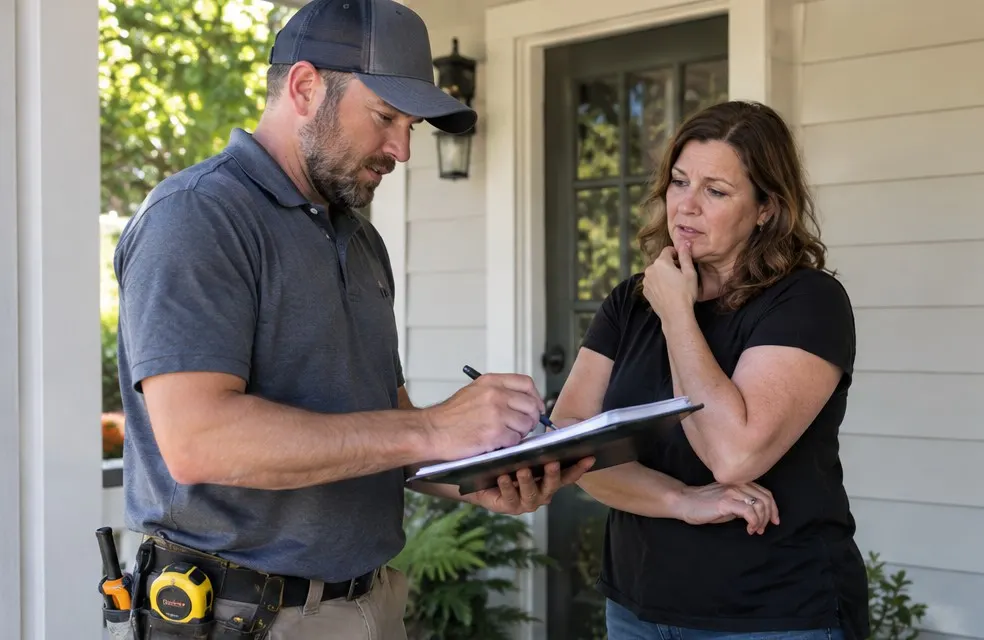
Free estimates feel like good customer service. For a handyman, they are often the most expensive thing you do. A 40-minute round trip to look at a $150 job, three times a week, costs you a full working day every month. The fix is to quote most jobs without leaving your current one, and to make the estimates you do write easy to say yes to.
Sort jobs into three groups
1. Quote online or on the phone
Jobs you do every week and can price from a short answer:
- TV mounting: how many TVs, what size, what wall, wires inside or outside
- Furniture assembly: how many pieces, which ones
- Drywall patch: how many holes, about how big, a photo
- Door adjustment, lockset, fixture swap: one photo is enough
For these, an estimating calculator on your website does the work. The customer picks the job, the count and the extras, sees your price range and books.
2. Quote from photos
Jobs where a photo answers most questions: water stains, rotted trim, a gate that sags, a cabinet door that hangs. Ask for two or three photos and a tape measure in the frame. Reply with a range and a note: "Final price confirmed on site."
3. Visit first
Only when the job is bigger than half a day, involves something you cannot see (behind walls, under floors), or the customer is comparing three bids on a $2,000 project. Even then, consider charging a trip fee that you credit back if they book.
What every handyman estimate should include
- Your business name, phone and license or insurance status
- What you will do, in plain words: "Patch two holes in the hallway wall, about 4 inches each, texture to match, prime. Painting not included."
- What you will not do: this prevents the "I thought you were also..." conversation
- Price: a fixed price per task, or hours times your rate with an estimate of hours
- Materials: included, at cost plus markup, or supplied by the customer
- Add-ons offered: paint touch-up, haul-away, extra TV, same-day visit
- When: the date or the first open slot
- How to pay: card on completion
Give a range for hourly work, then stick to it
For lists of small fixes, say "about three hours, $295 to $380". If you see it will run over, tell the customer before you pass the top of the range, not after. Customers forgive a longer job. They do not forgive a surprise on the invoice.
Offer options
Two or three options close more often than one number:
- Basic: mount the TV, wires on the wall in a cord cover, $159
- Clean: wires hidden inside the wall, $249
- Complete: wires hidden, soundbar mounted, devices set up, $319
Most customers pick the middle one. Without options, many would have taken only the first.
Speed beats price
The handyman who sends the estimate first often wins, even at a higher price. Homeowners want the problem gone. If you can reply with a price within an hour (or instantly, on your website), you beat the handyman who says "I'll come by Thursday to take a look."
Common estimate mistakes
- Vague scope. "Fix wall" invites an argument. "Patch two 4-inch holes, texture, prime" does not
- No materials line. Customers assume materials are included unless you say otherwise
- Pricing below your minimum because the job "only takes 20 minutes"
- Waiting until the evening to send quotes from the day's visits. By then, the customer may have booked someone who replied from the driveway
Follow up once
If the customer has not booked in two days, send one message: "Still want the TV mounted? I have Thursday morning open." That single text closes a surprising number of quotes. More than two follow-ups feels like pressure.
Turn estimates into a system
Keep your common job prices in one place so your website, your phone answers and your written estimates all say the same number. Read handyman prices for common jobs to build the list and how much to charge as a handyman to set the rate behind it. When the numbers are on your site, most customers quote themselves before they ever call.
Frequently asked questions
Should a handyman charge for estimates?
For small jobs, quote from photos or your website instead of visiting. For larger jobs that need a visit, many handymen charge a trip fee that is credited back if the customer books.
What is handyman estimating software?
A tool that prices jobs from your rates: by the hour, by the task, with add-ons. The most useful kind sits on your website so customers can price small jobs themselves.