How to Get More Google Reviews as a Handyman
What Google and the FTC allow when a handyman asks for reviews, a text to send every customer, how to count your own review rate without a target, and how to answer good and bad reviews.
 HandyPilot6 min read
In this article
Ask every customer after every paid job, send a link instead of telling them to search, and reply to each review. Google allows asking: its help page says that to leave reviews, you can ask customers to visit a Google link or scan a QR code. It does not allow paying for reviews, asking only the customers you expect to be happy, or telling people what to write. Nobody can promise you a number of reviews, so this guide gives you a routine and a way to count, not a target.
This guide is for the United States. Rules are quoted from the pages we read on 15 November 2026 and platform rules change, so open the links before you build a habit around them. The numbers in the example are round example numbers and assumptions: replace them with yours. Nothing here is legal advice.
What does Google allow when you ask for reviews?
Google writes two sets of rules: one in its Business Profile help and one in its policy for contributions to Maps. Together they say this:
| You can | You cannot |
|---|---|
| Ask customers to visit a Google link or scan a QR code | Offer free or discounted goods or services in exchange for reviews |
| Ask every customer you served | Selectively solicit positive reviews from customers |
| Reply to each review in public | Require or pressure people to write one while they are on your premises |
| Thank people by name | Ask that specific content be included |
The sources for each cell are below.
Incentives first. Google's help page says that offering incentives, like free or discounted goods or services, in exchange for customers to post reviews is prohibited. Its policy page lists reviews or ratings that have been paid for, directly or in kind as fake engagement, which is not allowed and will be removed. That also covers a "$10 off your next visit if you post a review" text, even from a customer you like.
Now the part many owners miss, because older advice says the opposite. The same policy lists, among things to avoid, discourage or prohibit negative reviews, or selectively solicit positive reviews from customers. So do not build a flow that asks "How was it?" and sends only the happy answers to Google. This is called review gating, and Google's page names it. The FTC's questions and answers on its own reviews rule include the question can my business ask for reviews only from customers whom we think are happy with our services? and that rule went into effect on October 21, 2024. Whatever the FTC answer says about its own rule, Google's policy is the one that removes your reviews, so ask everyone.
The policy also says to not request that specific content be included and that merchants should not require or pressure users to leave ratings or write reviews while on the premises. So drop the line "if you mention the TV mounting, that helps" and do not hand a customer your phone in the living room. Ask, send the link, and let them write it later.
The FTC's rule is about the way you ask too: you can't suggest to consumers that their reviews must be positive (or negative) in order to obtain a promised incentive, so a thank-you must never depend on the rating. The FTC page says that the rule authorizes courts to impose civil penalties for knowing violations. Ask for a review, never for a good one.
When and how should you ask?
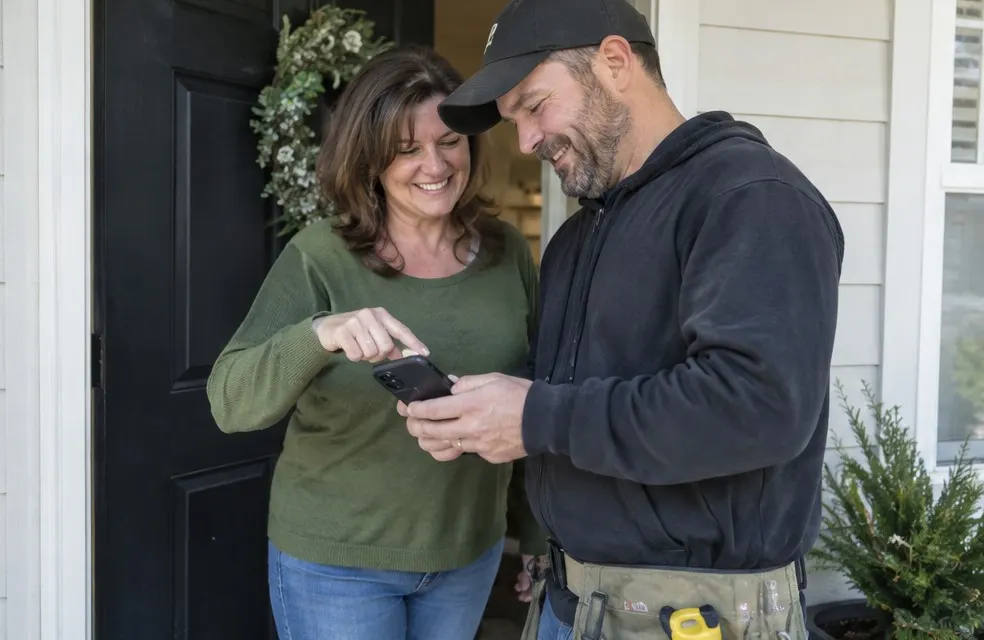
Ask after the work, when the customer has seen it: the TV is on the wall, the door closes with one finger, the patch is gone. Say it in person, then send the link by text, so it takes one tap:
"Thanks again for having me today. If you have a minute, a Google review helps other homeowners find a handyman. Here is the link: [link]. If anything is not right, reply here and I will come back."
That last sentence is a service promise, not a filter: everyone gets the same text and the same link. Send one reminder two or three days later to people who have not answered, and stop there.
Where do you get the link? From your Business Profile. Google also offers a QR code. Its page says that reviews QR codes can only be generated on a computer browser, not on mobile devices, so make it once on a computer and print it on your invoice or your business card. If you use HandyPilot, the review requests go out the day after you mark a job done, by text or email, with your Google review link, for every job. HandyPilot does not promise a number of reviews and does not let you pick who gets asked, and you should not either.
How many reviews will you get?
Nobody knows yours until you count. Use this method:
- Count the jobs you completed last month, say 32 (an example).
- Ask all 32.
- At the end of the month, count the new reviews, say 6 (an assumption to show the sum).
- Divide: 6 / 32 = 19 percent of the customers you asked wrote one.
Next month, ask all of them again and compare. If the share is low, change the way you ask, not who you ask: send the text sooner, shorten it, put the link in the first line. Do not set a number of reviews to be collected by your helpers. Google's policy lists merchants requesting that staff solicit a certain number of reviews among the things to avoid.
What about the star rating?
Google says that the review score is the average of all ratings published on Google for that place or business, and that after someone leaves a new review, it may take up to 2 weeks to get an updated review score. So do not panic or ask for a rewrite when the number does not move the same day. Google also says that more reviews and positive ratings can help your business's local ranking, which is a reason to serve every customer well and ask every customer, not a reason to ask for a good one.
How do you answer reviews?
Google's page on replying says to show customers that their feedback matters. It adds to address the reviewer by name and acknowledge their specific feedback. Do not paste the same answer under every review.
A good review: "Thanks, Laura. Glad the TV is up and the wires are out of sight. Call anytime."
A bad review: reply once, with facts and an offer to fix it: "Sorry the door is still rubbing, Mark. I would like to come back and adjust it. Please call me at [number]." Google's guidance says to never share a reviewer's private information or engage in personal attacks and, if a situation is complex, to politely request that the reviewer contact you via phone or email to resolve the issue privately. It also says that your reviewers are already customers, so avoid using your response to offer deals or promotions. So the reply fixes the problem and does not buy a changed review.
Do not offer a customer anything to change or remove a review either: the incentive rule above covers it, and the policy page lists a revision or removal of a negative review among the things an incentive may not buy.
Which customers are easy to forget?
Regulars: property managers, realtors and repeat homeowners. They feel like friends, so owners skip them. Ask them the same way, with the same text. A review that says someone has used you for every repair in three rentals is the one a new customer reads twice. You must not ask for those words, and you can thank the person for what they wrote.
What do you do with the reviews?
Show the rating and a few recent reviews near the price and the booking button on your site: that is where a visitor decides. A handyman website can carry them on each job page. For the rest of the Google setup, read the Business Profile guide for handymen, and for how reviews fit with the other ways to find customers, read how to get handyman customers.
Frequently asked questions
How do I ask a customer for a Google review?
Ask every customer after every paid job, then text the same link to all of them. Google says you can ask customers to visit a Google link or scan a QR code. Do not ask only the customers you expect to be happy.
Can I give a discount for a review?
No. Google's help page says offering incentives, like free or discounted goods or services, in exchange for reviews is strictly prohibited, and paid-for reviews are removed.
How many Google reviews can I expect?
Nobody can promise a number. Count the customers you asked in a month and the reviews that came in, and divide. Change how you ask, not who you ask.
How do I answer a bad Google review?
Reply once, by name, with the facts and an offer to fix it, and take complicated cases to a phone call or email. Do not share the reviewer's private information, argue, or offer a deal in the reply.